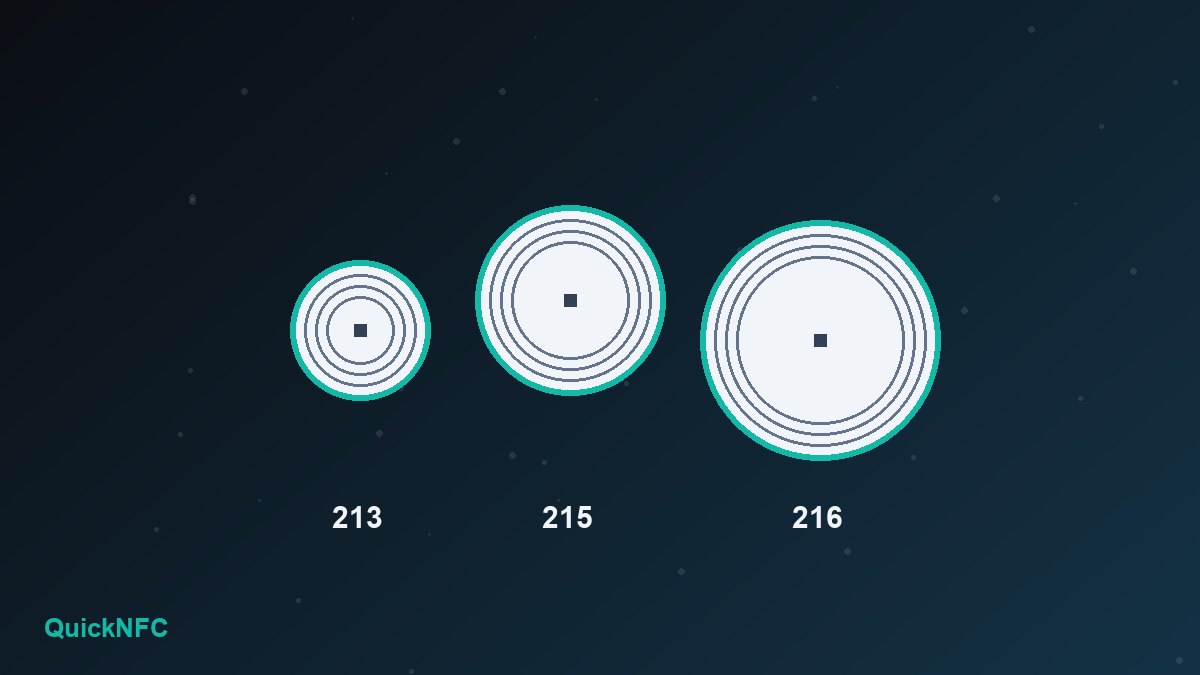
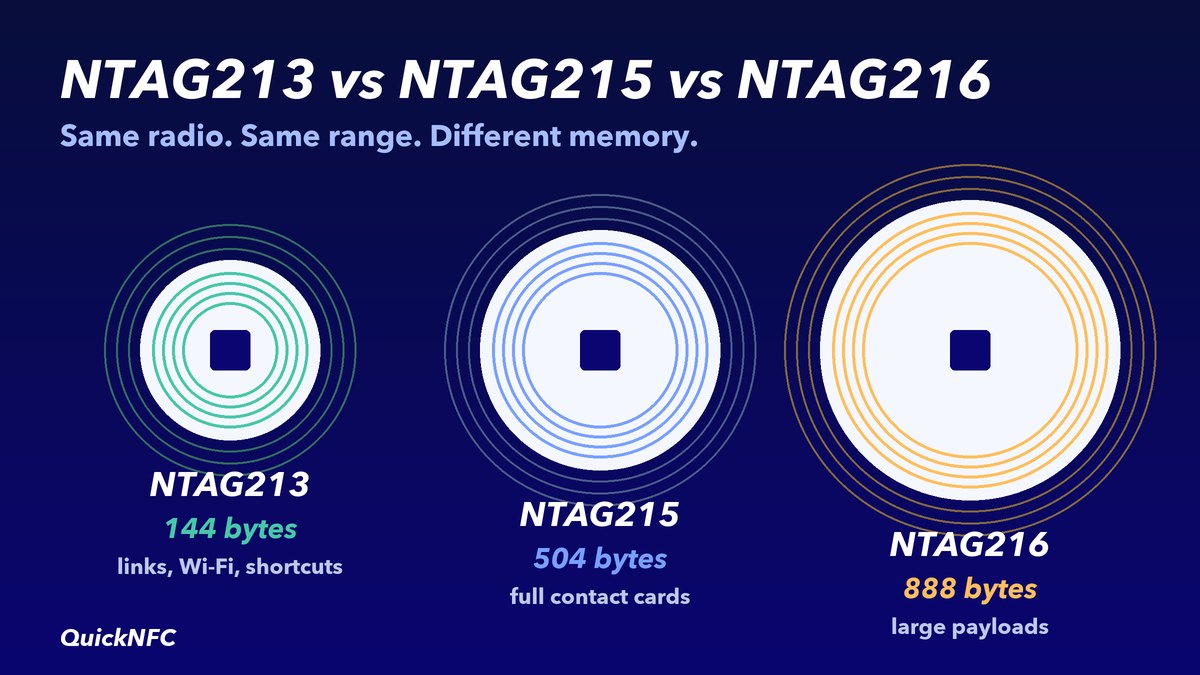
Short answer: for a link, a Wi-Fi code or a review page, buy NTAG213. For a full contact card or a longer message, buy NTAG215. NTAG216 is only worth it when you really need to store a lot of data on one tag. All three are the same kind of chip from NXP, they work with iPhone and Android, and they read at the same range. The real difference is how many bytes you can write.
That is the part most listings skip. Sellers print "NTAG213", "NTAG215" or "NTAG216" on the packet and leave you to guess. This guide uses NXP's own datasheet for the numbers, then shows what actually fits on each tag with three examples we measured ourselves. If you want the wider buying checklist (surfaces, sticker or card, on-metal), start with our guide to the best NFC tags to buy and come back here for the chip decision.
NTAG213 vs NTAG215 vs NTAG216 at a glance
| Chip | User memory | Total memory | Good for |
|---|---|---|---|
| NTAG213 | 144 bytes | 180 bytes | Links, Wi-Fi codes, short text, shortcuts |
| NTAG215 | 504 bytes | 540 bytes | Full contact cards, longer messages, several records |
| NTAG216 | 888 bytes | 924 bytes | Big payloads, multiple records on one tag |
Source: NXP NTAG213/215/216 datasheet. "User memory" is the part you can write. The rest holds the serial number, lock bits and configuration, so you never get all of it.
What stays the same on all three
People often assume the bigger chip is a "better" chip. It is not, in the ways that decide whether a tap works:
- Same standard. All three are NFC Forum Type 2 tags on the ISO/IEC 14443 Type A radio standard, which is what phones read.
- Same input capacitance. NXP lists 50 pF for all three. Read range depends mostly on the antenna size, the tag's form factor and what it is stuck to, not on whether the chip holds 144 or 888 bytes.
- Same features. Each has a unique 7-byte serial number, 32-bit password protection, a read-only lock, an NFC counter and an ASCII mirror option (it can write the tag's serial number or tap count into a link automatically).
- Same durability numbers. The datasheet quotes 10 years of data retention and 100,000 write cycles for the family.
So the choice is really one question: how much do you need to store?
What actually fits: three real examples
We built three typical NDEF messages and counted the bytes, including the small header each record carries.
| What you store | Size we measured | NTAG213 (144) | NTAG215 (504) |
|---|---|---|---|
Short link, https://quicknfc.com/l/abc123 | about 29 bytes | Fits easily | Fits easily |
| Long campaign link with three tracking parameters | about 91 bytes | Fits | Fits easily |
| Contact card (vCard) with name, company, title, mobile, email, website | about 199 bytes | Does not fit | Fits |
| Same contact card plus work address and a note | about 284 bytes | Does not fit | Fits |
These are our own counts for sample content, not manufacturer figures, and your numbers will move with the text you write. The point is the pattern: a link is tiny, a contact card is not. If you are making tap-to-save contact cards, our digital business card explainer covers why most people end up storing a short link instead and letting a web page hold the details. That keeps you on the cheaper chip and lets you update the details later without rewriting the tag.
When NTAG213 is the right pick
Pick NTAG213 when the tag points to something rather than carrying it:
- A review page, menu, booking page or product page. See how to set up an NFC Google review card.
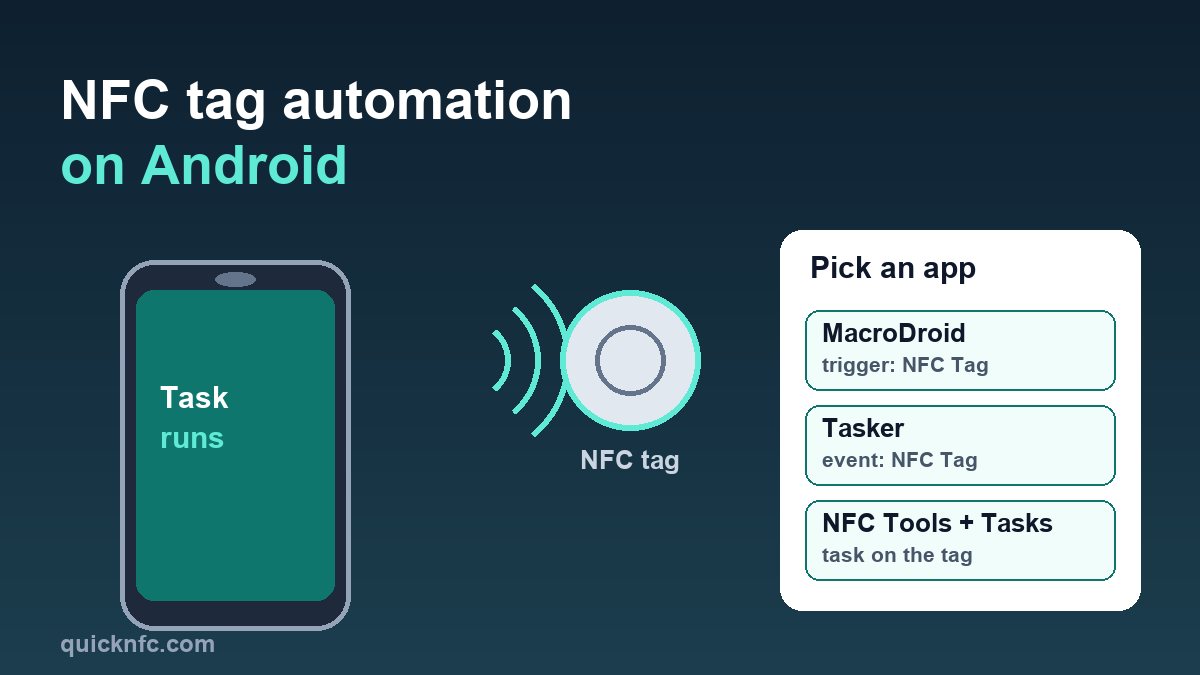
- An iPhone Shortcuts trigger. The tag only needs to be recognised, so even a few bytes is enough; our NFC tag automation guide shows the setup.
- A Wi-Fi sharing tag for guests (a network name and password take roughly 50 bytes).
- Anything you will stick up in bulk. NTAG213 is the most common chip, so it is usually the easiest to find in stickers, cards and coins.
When to spend a little more on NTAG215
NTAG215 earns its place when the data itself must live on the tag, for example:
- A complete vCard that should work with no internet connection.
- A longer message or several records on one tag (a link plus a short text plus a phone number).
- A tag you may want to reuse for something bigger later, so you are not buying twice.
If you are weighing up cards for a business, are NFC business cards worth it? looks at the whole decision, including whether you need the extra memory at all.
When NTAG216 makes sense
Honestly, for most readers it does not. 888 bytes is useful if you store a detailed contact profile, several records on one tag, or an NDEF message you plan to expand. If you find yourself needing that much, ask first whether a short link to a web page would do the job better. A page can be edited and tracked; bytes on a tag cannot be changed after you lock it.
Chips to be careful with
Always check the chip name before ordering. Listings that only say "NFC sticker" can use other chips. Android's developer documentation notes that MIFARE Classic and MIFARE Ultralight support is optional on Android devices, so a tag built on those chips may not read on every phone. NTAG chips are the safe baseline for phone-facing tags. If a tag stops reading after you write it, our iPhone fix list and Android fix list cover the usual causes.
Mistakes to avoid when you buy
- Buying by memory alone. Memory is not range. A well-made NTAG213 sticker can outperform a poorly made NTAG216 card.
- Locking before testing. The read-only lock is permanent. Test on both an iPhone and an Android phone first. More in how to write NFC tags without wasting them.
- Ignoring the surface. A plain tag on a metal sign or phone case can fail whatever the chip. Metal-ready tags are a separate product, see common NFC mistakes.
- Storing what should be a link. If the content may change, store a link and keep the content on a page.
- Skipping a test batch. Order a handful first. Quality varies between sellers more than between chips.
A simple rule for choosing
- Will the tag hold a link, a short text or a Wi-Fi code? NTAG213.
- Will it hold a full contact card or several records? NTAG215.
- Will it hold something larger than that, and a web page really will not do? NTAG216.
- Not sure? Write the exact message you plan to use in a free NFC app, check the byte count it reports, and pick the smallest chip with room to spare.
Quick FAQ
Is NTAG215 better than NTAG213?
Only if you need the extra memory. NTAG215 has 504 bytes of user memory against 144 bytes on NTAG213. The datasheet lists the same 50 pF input capacitance and the same feature set for both, so there is no built-in range advantage.
Do iPhones and Android phones read all three?
Yes, in normal use. They are standard NFC Forum Type 2 tags carrying NDEF data, which is what phones are built to read. Older or low-end phones, case thickness and metal surfaces cause more trouble than the chip does.
Can I upgrade an NTAG213 to more memory?
No. Memory is fixed in the chip. If a message outgrows a tag, you need a bigger chip or a shorter message.
How long will the data last, and how often can I rewrite it?
NXP's datasheet quotes 10 years of data retention and 100,000 write cycles. For a tag you set once, that is more than enough.
Which chip do I need for a Wi-Fi sharing tag?
NTAG213. Our sample Wi-Fi record with a network name and a password of about 20 characters came to roughly 50 bytes.
Sources
- NXP Semiconductors, NTAG213/215/216 datasheet: NFC Forum Type 2 tag compliant IC with 144/504/888 bytes user memory
- Android Developers, Advanced NFC: supported tag technologies
- Apple Developer, Adding support for background tag reading

QuickNFC Editorial DeskQuickNFC publishes practical, plain-English NFC guides. Spotted an error or something out of date? Tell us.